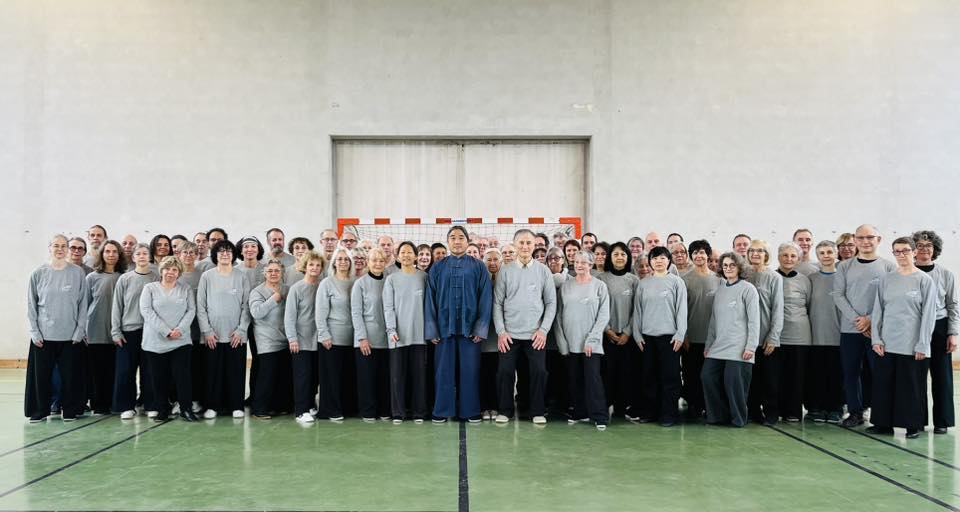
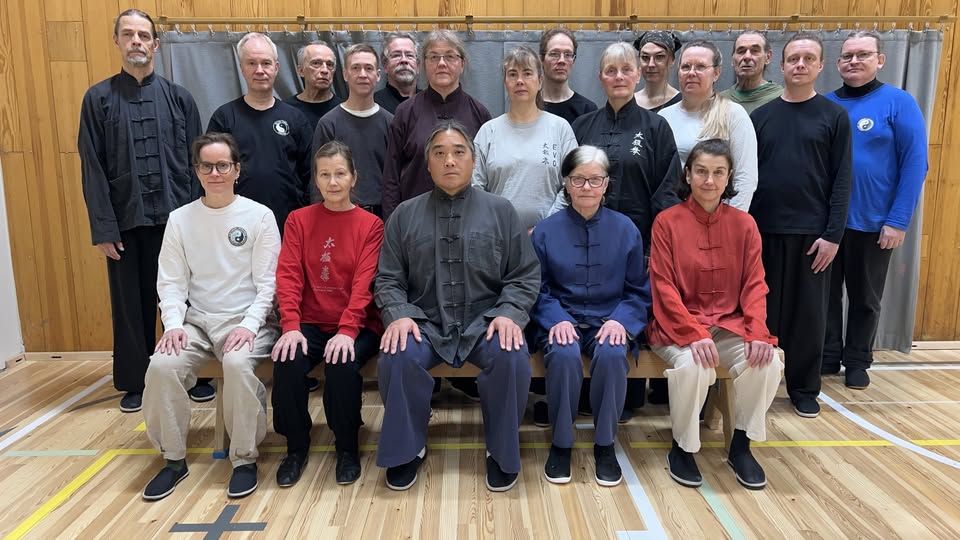
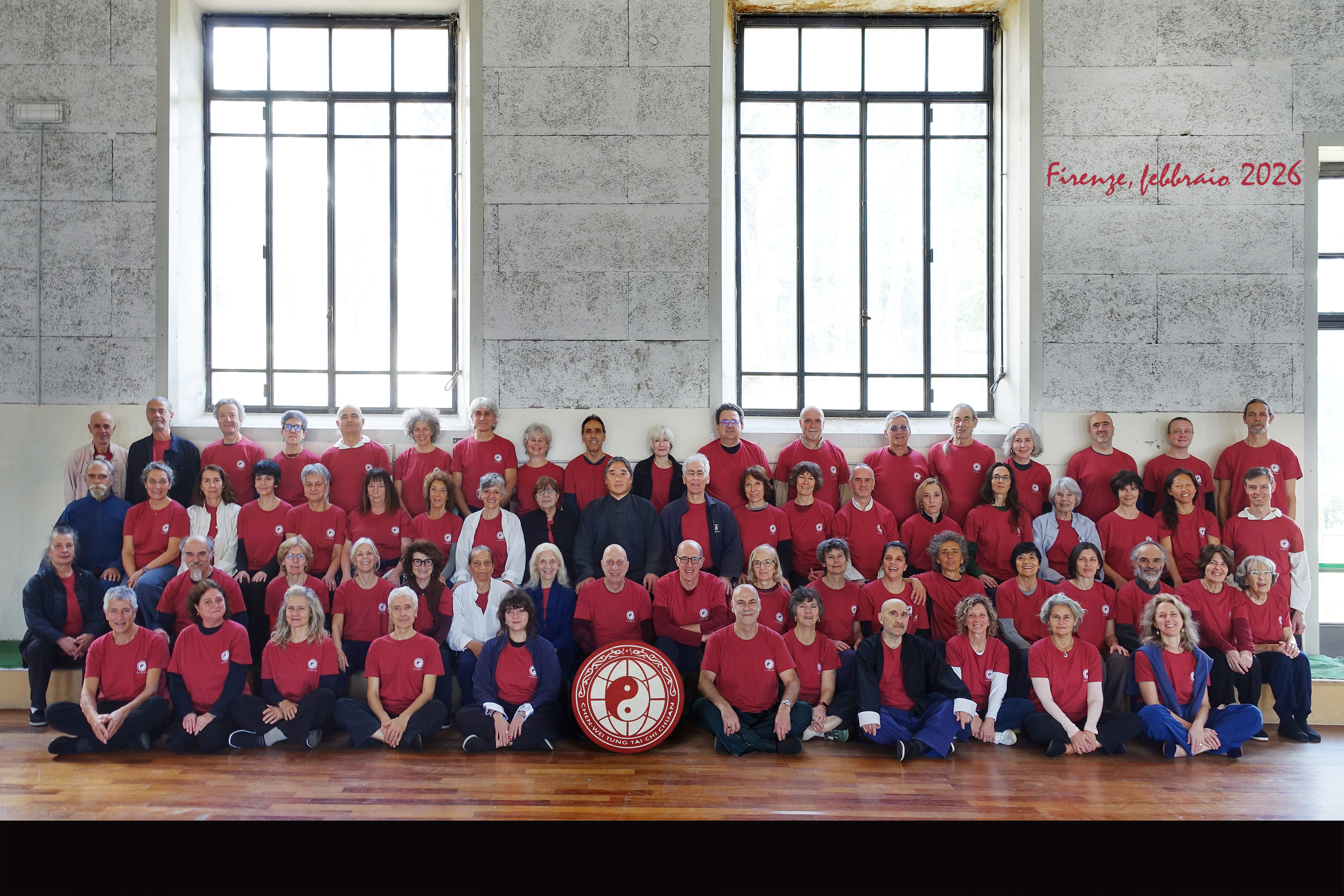
This February we had a seminar in the Pyrenees for the second time, one in Helsinki right after, and this time the first one in Florence. In every place we had five classes. The first and the last locations had over sixty students. It really does feel special to practice with a big group, but in contrast, in Helsinki the atmosphere was unique in its own way, with the focus on finding very fine timing.
One theme the master emphasized was how to start, 起 qǐ, to raise - like in Tai Chi starting movement, 太極起式 tàijí qǐ shì. This is also what the master says when we begin the form. Raise your hands at the same time with the whole group, as if all the students were shadows of the master. And just like a shadow follows, everyone should follow and keep the same speed.
One thing that makes keeping the pace together easier is when the master says when to shift your weight - 弓腿 gōng tuǐ, 坐腿 zuò tuǐ - or turn your waist, 转腰 zhuǎn yāo. So when you hear this, make sure you are doing what he says. Listen, 听 tīng.
The beginning is also very important when you practice with a partner. Follow your partner, raise your hands, bend your knees, take the steps, shift your weight, and do all the movements at the same time. Your partner is your shadow, like master said - not literally, but doing the counter movement, only reacting when your partner is acting, like a mirror, together. 你不动。我不动。 你欲动。我先动。
When learning new drills, like three steps, 三步 sān bù, or four corners, 大捋 dà lǚ, it is good to practice especially how to start. Here you are closer to your partner than in regular push hands, 推手 tuīshǒu, and you count to three. One is raising your hands, bending your knees, and making contact. Two is a small step or turn. And three is a big step and the movement, 擠 jǐ, 靠 kào, or 捋 lǚ.
In all partner practice always keep contact. Even with distance, think as if you still have a connection. Don't rush ahead. Try to stay on top and control, even while retreating in one hand push hands. When pulling, control your partner's elbow. Only the pull is backward. Even though you seemingly go back in 掤 pèng too, the intention is forward - to extend your arm and push a little. Timing is very critical here, just before your partner begins to push you.
When counting, every count is a step. In three steps, the first is just picking up your foot and stepping it back. The second step is long while continuing the movement. And the third is long and finishes the movement. The change is just one count - one big step, a changing of movement, just like the beginning, and a change of direction, clockwise or counterclockwise. In four corners one step is only a turn. In stationary and single step practice the counting is actually different, to four: a step or follow step, or just shifting your weight or turning your waist.
Don't make a sound with your steps - a shadow is silent - step softly. Also, no talking. Even when teaching you don't need to verbalize everything; you can simply point out where to focus. Give your partner time to figure things out on their own.
A shadow is just the absence of light. We see only light, so it's about what we do not see - what we are unaware of, unconscious of. You can also use your own shadow as a mirror. I think people could have used shadows to study their posture while practicing even before mirrors were that common.
I have a light in the center of my room, so I can see my own shadow in all directions. I don't look at it constantly, but it is one way to pay attention to what I am doing. I have also filmed my own practice to observe how I was moving. In this sense, you can use a camera as a third eye.
More generally, all fellow human beings can be seen as our shadows or mirrors. Usually, if someone triggers strong emotions in us, it is a sign that they reflect hidden parts of ourselves. Happiness is easy to share, but negative emotions - such as envy, contempt, or shame - may be a sign that we have not yet fully connected with that side of ourselves. Personally, I try to work with my own shadow and accept myself as I am, gently pushing it to grow. I would like to be a good example to others, although of course not everyone wants to be like others.
But now it is time for me to hide back in my own shadow...