This year in Winter camp in Felton, California, we focused heavily on slow set. The goal was to practice it eight times per day: three sets in every class, and the rest on your own. Do your own way - a little bit, like master said. Practice in all different ways: slow, fast, lower, bigger, holding postures, naming the movements, facing all directions, thinking about applications, adjusting steps - for example taking the first step back in the fair lady works the shuttle, 玉女穿梭 yùnǚ chuānsuō, or in cloud hands, 云手 yún shǒu. Even in class we sometimes did slow set on our own. Take your own space. Be aware of others, but keep your own set continuous.
Grandmaster also spoke about practicing your own way, your own unique style the last time he was in Helsinki in February 2019. He even joked that one day there would be my teacher's style. It's truly remarkable how much variation exists among his students. That same year, at the French camp, we aimed to complete slow set in twelve minutes, ten times in a class. Master demonstrated it once, and his timing was impressively precise. During the first few days we practiced just on our own, lining up together only in the middle of the camp. In contrast, the slowest slow set I've ever practiced was in Lapland - over ninety minutes.
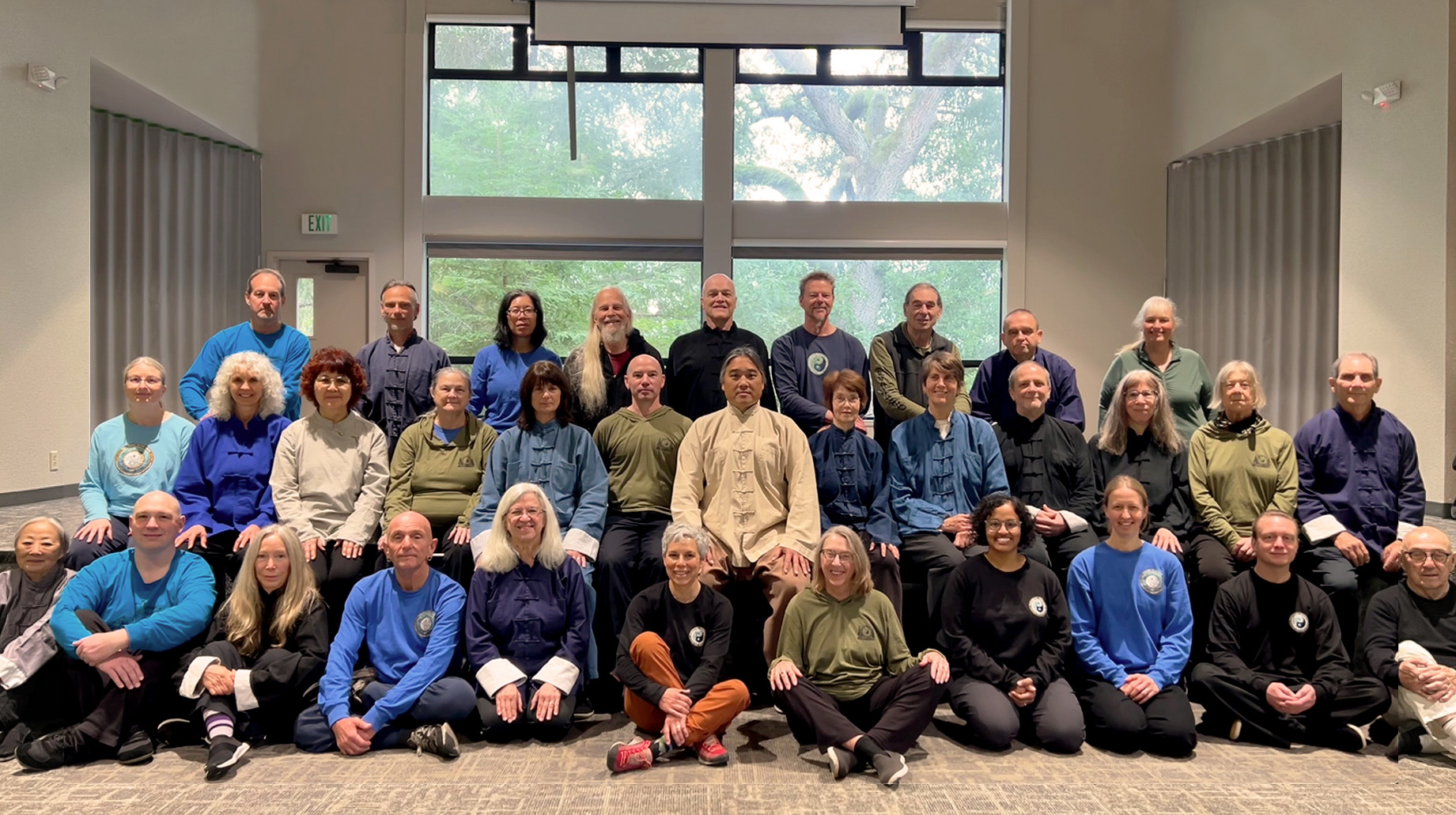
One good way to practice all the movements is to begin any movement from the preparation, 预备式 yùbèi shì. Master called the movement name in Chinese, and we followed by performing it. From there you can also practice movements in many ways: in any direction, to either side, left, 左 zuǒ, or right, 右 yòu. Even though you can do carry tiger back to the mountain, 抱虎归山 bào hǔ guī shān, forward, you should also practice turning to the back corner as in the slow set.
To practice new ways, I've been focusing on learning the Chinese names of the movements. One thing I've been wondering about is the difference between 进步 jìnbù and 上步 shàng bù, both translated as step forward. Similarly, I've studied the distinctions between the different ways of turning the body and how they are named. Maybe I don't need to explain all the differences - simply paying attention and thinking about them may already change how you practice.
- fist near the waist, 撇身捶 piē shēn chuí
- turn back and heel kick, 轉身蹬腳 zhuǎn shēn dēng jiǎo
- twist body and right heel kick, 斜身右蹬脚 xié shēn yòu dēng jiǎo
- sit back and right heel kick, 回身右蹬腳 huí shēn yòu dēng jiǎo
- turn around and right heel kick, 轉身右蹬腳 zhuǎn shēn yòu dēng jiǎo
- turn around and cross-kick, 轉身十字腿 zhuǎn shēn shí zì tuǐ
- turn around and slap-kick, 轉身雙擺蓮 zhuǎn shēn shuāng bǎi lián
Doing your own way also means not having the same experience I had. I'm sure someone else would have very different notes from the camp. What you learned might be very different. But one common thing I heard others mention was how clear and easy to follow all the teaching was. Someone remembered how confusing it felt to learn big pull, 大捋 dà lǚ, the first time, yet this time we were happy to see how simply it can be taught.
I like to think novelty is a blessing in life - in profession, occupation, hobbies, skills, talents, wherever it appears. Do your own way, your own style, your own best. Try everything. Drop what doesn't serve you and keep what improves you. I've had many phases, jobs, interests, goals, and dreams, and I'm still looking for new ways to spend my life - though I'm sure that 太极拳 tàijí quán will remain my major focus.