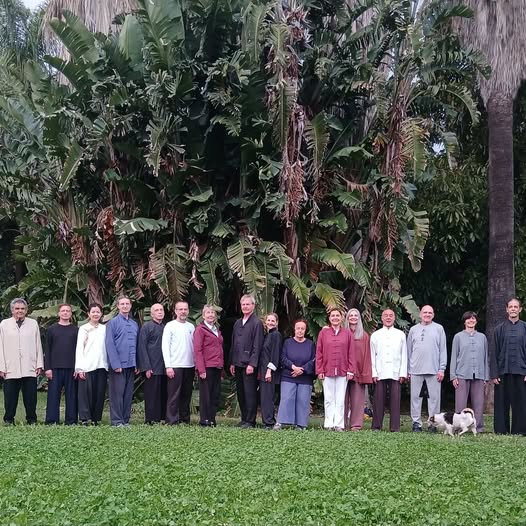
This spring my teacher held a camp near Etna for the second time. For the new students, he emphasized that we are really studying how to use our bodies, and that the sets are tools for improving that understanding. Be aware of your body, as he said. After the camp, I have continued embodying that idea of body awareness, and here are some notes on what I remember and what I have found out since.
Focus first on your root, sinking, and sitting on the legs, and then on shifting your weight and turning your body. Your posture should be firm and straight, but not upright. Keep your chest slightly rounded. Relax your shoulders. Keep your elbows down, or heavy. Twist your arms. Turn your wrists. The hands are the last detail, but be careful with your fingers - they are delicate and break easily.
Pay attention to how your whole body works as one, and to how you move, stand, sit, or even lie down. Try to think about what is happening in your body. Be in your body. Don't watch too far. It is not enough to be merely watchful and mindful, but bodyful as well. Feel all parts of your body. Feel them at rest and in motion. See the finer movements within movements. Keep yourself together, don't drag. Be aware of all tension and looseness. Be relaxed, not floppy. When the body relaxes, the mind relaxes as well. Don't try to control your breath, but notice how it naturally slows down and deepens when you relax.
One way to understand the action behind everything you do is to try to name it, even if only with a single word. Practice both sides, left and right, and you will discover all the differences. You should use your body diversely. If you always do the same thing, and that thing is incorrect, you only reinforce the mistake. If you think something is unimportant, that you don't need to know it, or that you can never improve, then that is exactly what you will get - or rather, you'll never get it.
In push hands, be aware of your partner's body as well. Use your wrists and palms to connect with your partner. Don't lean, but if you feel your partner leaning on you, you can use it against them. With weapons, think about how you hold and feel them. Do you squeeze them, or hold them too loosely? Think of them as part of you, or as an extension of your being. Know your dimensions, just as you would be aware of a car while driving or parking it. Map your body and your surroundings.

Just as thoughts are the language of the mind, emotions are the language of the body. Emotions create thoughts, and vice versa. Pay attention to your feelings. What is your body telling you? Can you even locate your emotions within your body? Interest is an emotion of its own, and it can grow into excitement. Naming your emotions already helps to understand them, as well as the emotions of other people, and helps you become more empathetic toward others. Emotionally intelligent people are often more verbal when describing how they feel - not merely fine, but aware of how they are moved. Be precise with your expressions.
Emotions control us unless we learn to recognize them. Let go of negative emotions to make room for positive ones. I once heard that happiness is peace in motion, and peace is happiness at rest. It also reminds me of what the grandmaster has said: The goal is not to demonstrate strength, power or violence. The goal is to attain serenity, tranquility, and the discovery of oneself. It is truly an exercise of the mind.
Practice should make you feel relaxed, energized, and high spirited. When the body feels good, the mind feels good. Be open to change. Be open minded. Adapt to changing conditions, 隨機應變 suíjīyìngbiàn.