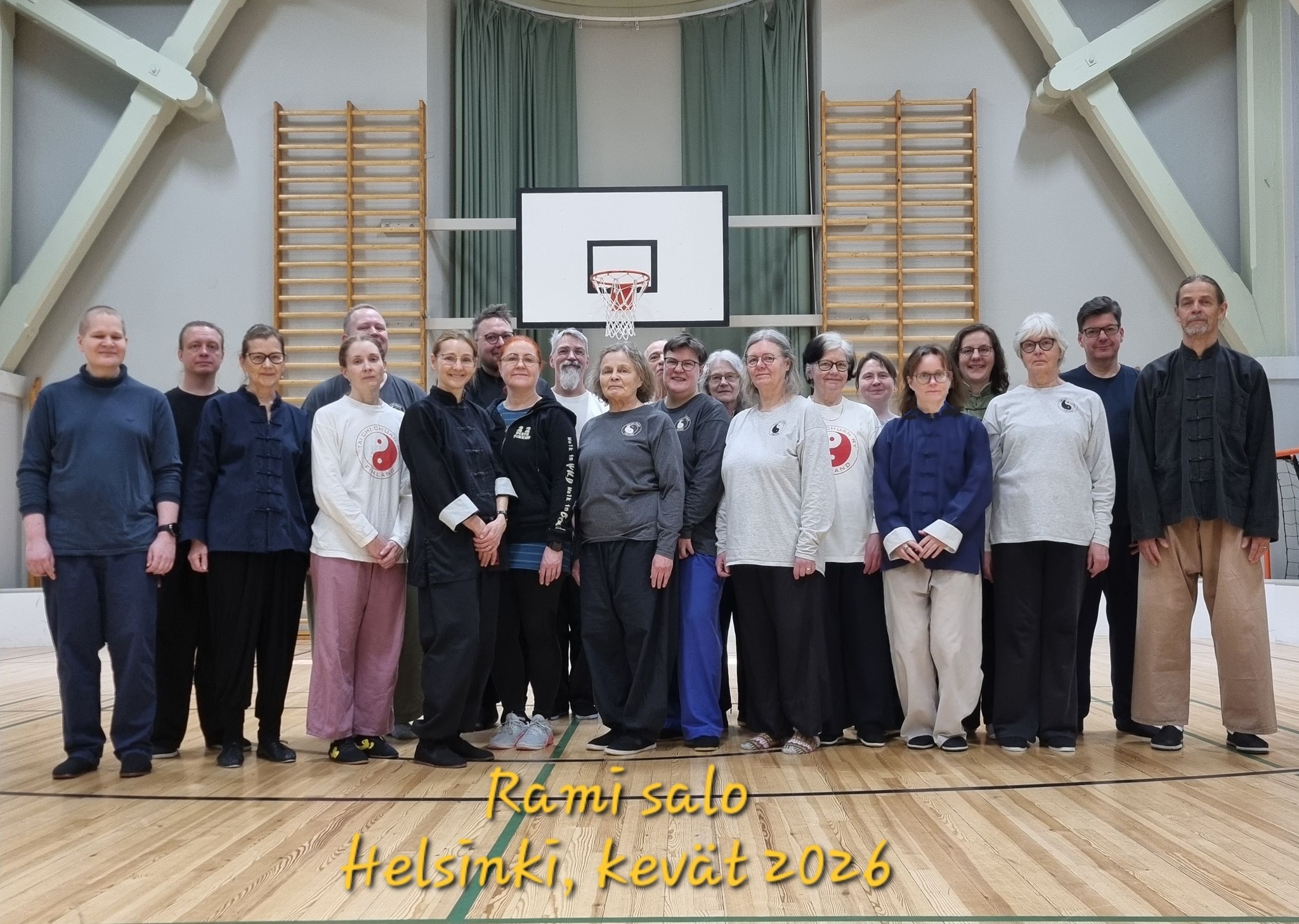
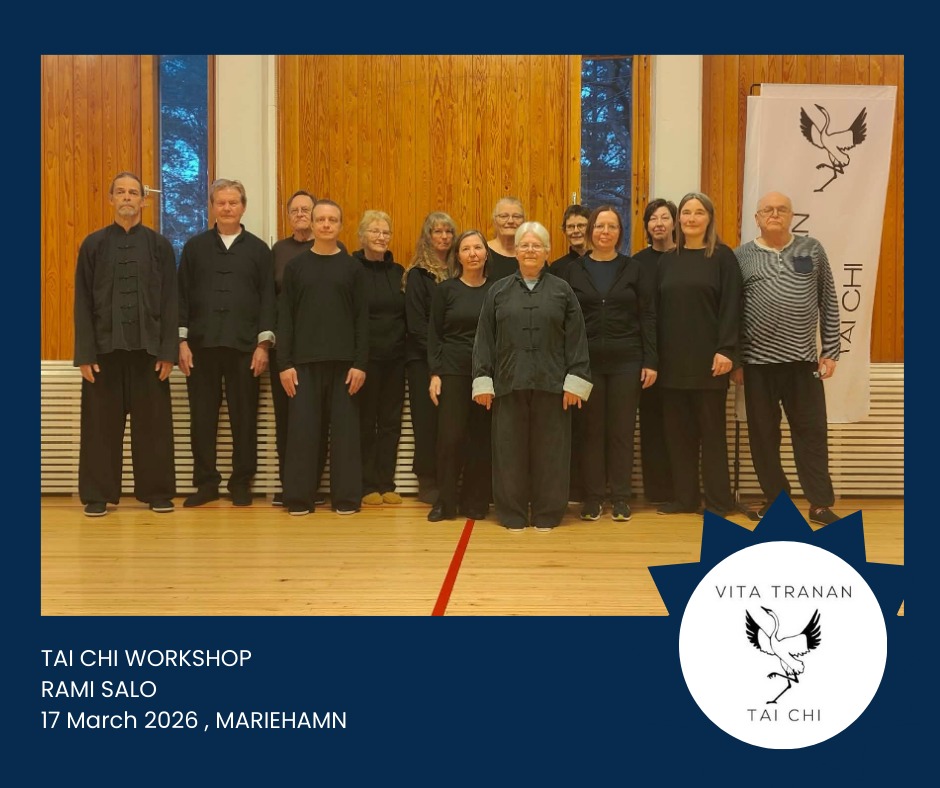
My teacher was visiting Finland this month, and I had twelve classes with him. We practiced in three different places, and in all of them we also had some beginners. With them, we focused only on the first section, very clearly and precisely, step by step, splitting all movements to smaller parts or phases, usually counting with small stops to emphasize the separation of what we actually practice, instructions, hints, and phrases you may hear. Maybe I'll just call them tips for now.
The ordering of these tips varies between movements, but they appear simultaneously in all of them throughout the whole set. Stretch your arms. Raise your hands. Turn your wrists. Relax your shoulders. Relax your elbows. Bend your wrists. Bend your knees. Sink. Sit on your leg. Turn your waist. Turn on your heel. Take a long step. Circle your hands. Shift your weight. And your own favorites.
All the tips can be separated within a movement, focusing on them independently and at the same time. You can think these tips as the alphabet you have to learn before you can read and write - to compose full movements. It's good to practice them on their own and together. The combinations, timing, and alignment change, but they are all present all the time.
Play with those tips by stopping, 停 tíng, not really stopping, but slowing down so much that it appears still, still practicing the intention - 意 yì never stops. You may have heard to continue the movement in your mind, but I would say that continue it even with your body. Open or close more - or both. Use your body, as my teacher said. Try to feel everything. What you actually feel is the movement in motion - or simply emotion.
All the movements are about doing, verbs, not static postures, even though there is also the finishing point in every movement. Do all the tips fully, from beginning to end. Even if you fall behind in a group, don't take shortcuts - just do the whole movement faster to catch up. Do bigger. Sink more. Push longer. Does the body even have finite limits, or when are you actually ready? You can always do more. Don't rush, as my teacher said. Or, take your time, as master puts it. Finish more.
If you think about finishing movements, where do they really end? Or when does the next one begin? Even in finishing, continue. Nothing is ever truly finished. Pictures are usually taken at the end of a movement, but that phase is not still. If you are not clearly finishing before continuing, maybe you already started wrong. And if you start wrong, you cannot finish right. You should be able to be still without releasing the momentum, but continue cultivating it, 拿劲 ná jìn. Be determined and find the fullest point, where are you ready or truly willing to release it, 发劲 fā jìn. Personally, I think this momentum is very similar to what comes from opening your hands in 開合 kāi hé.
By taking the practice of all these tips to the extreme, you can try to divide movements into ever finer parts. Try to imagine even a hundred phases within one movement. How far can you really go? How many different ways you can practice a single movement? I would guess after ten thousand repetitions, you could have practiced it slightly different each time. Maybe there are limitless possibilities to refine any movement. At least mistakes are usually unique - losing a balance even a little bit and especially correcting the posture, is every time different. That alone proves that everything can be done in so many different ways. If you always do your best, you should improve every time.
I am often a little afraid of finalizing things, locking them to some arbitrary point in time and claiming they are done. It took me years to realize that my procrastination isn't about being lazy, but avoiding criticism - so much that sometimes I don't even want to be seen. Nobody wants to be judged. I have learned to let go of that, and I've found a lot more joy in simply enjoying what I do instead of focusing on what I should get from it. It's also comforting to know that nothing is ever fully finished. You can always go further, find new space to grow, and discover new ways to practice. Every day I feel more ready, especially when concidering that by not doing anything, you can open windows to anywhere - 無為 wúwéi. Let things brew first. A fruit falls from a tree when it's ready.
I never meant to be this open about myself, but apparently I feel safe sharing how I see things - being honest and vulnerable. Be open or closed. Tell or don't. Receive or not. Let go, or fall by holding on too tightly. Use it or lose it. Maybe one day I will have something else to share as well. Maybe I'll publish a video of my own practice, or write a book or poems - perhaps even in Chinese, 中文 zhōngwén.
Speaking of tips, one friend offered to pay me for my help, which gave me an idea to allow anyone to support me do what I love - focusing on practice and writing, learning and sharing. So if you'd like to buy me a coffee, I would be grateful.
One more thing about finishing - you may hear master say 下课 xià kè, to close the class. And now, it's time to close this post. I took my time, and I didn't rush.